How Do Commercial HVAC Systems Work?
Call 913-481-0505- Licensed, Bonded & Insured
- 20+ Years Diamond Strong
- WBE · DBE · SLBE Certified
- Top 10 Small Business
Blog > How Do Commercial HVAC Systems Work?
Your commercial HVAC system is vital for keeping your building safe and comfortable. But as with many technical systems such as plumbing or electrical, building managers don’t necessarily know how they work.
It’s recommended that you contact a commercial HVAC specialist for maintenance and repairs. But finding out how commercial HVAC systems work can help you keep yours in top condition and identify potential problems between professional checks.
What is a commercial HVAC system?
The acronym HVAC stands for heating, ventilation, and air conditioning. It’s a system that helps you control the temperature, humidity, and air quality of your indoor space.
Residential properties also contain HVAC systems. But commercial HVAC models have different features and challenges to home units. That’s because they typically need to handle large spaces and variable occupancy, and often have much more complex ductwork.
Commercial HVAC systems can be found in:
- Office buildings
- Hospitals
- Schools
- Hotels
- Retail stores
- Factories
- Warehouses
- Any other commercial space
How do commercial HVAC systems work?
Your commercial HVAC system facilitates 3 different processes that affect your working environment: heating, ventilation, and cooling.
Each process is carried out using separate units that, when combined, make up your overall HVAC system.
All 3 units are controlled using a central thermostat, or energy management system.
Heating
There are multiple types of HVAC heating elements:
- Radiant heaters that use infrared radiation
- Furnaces that burn fuel for heat
- Electric strip heat
- Heat pump system
- Hydronic heat systems
Once heat is created, it’s distributed throughout your building via pipework or ductwork using an internal fan and motor.
The system can use either gas, oil, or electricity to generate heat.
Ventilation
Air is drawn into your building using a specially designed air inlet unit within your HVAC system.
It then passes through a filter to remove dust and other contaminants. Finally, it’s sent through a series of flues and vent pipes and distributed evenly throughout your building.
Cooling
The cooling process of a commercial HVAC system works using refrigeration.
Refrigerants are used to absorb heat in the air. Then a compressor squeezes the air to increase pressure before transferring it to a condensation coil.
Here, heat is released and passed over an evaporator to turn it into liquid. As a result, the air temperature lowers.
Types of commercial HVAC systems
There are many different types of commercial HVAC systems . But most commercial buildings in the United States typically use either a single-split system, a packaged system, or a VRF/VRV system.
Single-split HVAC systems
This is the cheapest and most common type of HVAC system.
Single-split systems use a series of indoor units, each containing a cooling coil, a long blower, and an air filter. For every indoor unit there’s also a corresponding outdoor unit with a compressor, condenser coil, and expansion coil placed on or near the exterior of the room. These units are connected using electrical wires rather than ductwork.
The system’s simplicity makes it very easy to install. And since each room has its own unit, the rest of the system will continue working even if one unit fails. The fact that the noisiest components of the air conditioning system are housed outside also ensure a quieter, less disruptive process.
That said, the need for multiple units does mean businesses need to consider whether they have enough outdoor space for the external elements.
Single-split HVAC systems are commonly found in smaller premises such as small offices, restaurants, and cafés.
Packaged systems
Unlike split systems, packaged systems contain all heating and cooling components inside a single cabinet.
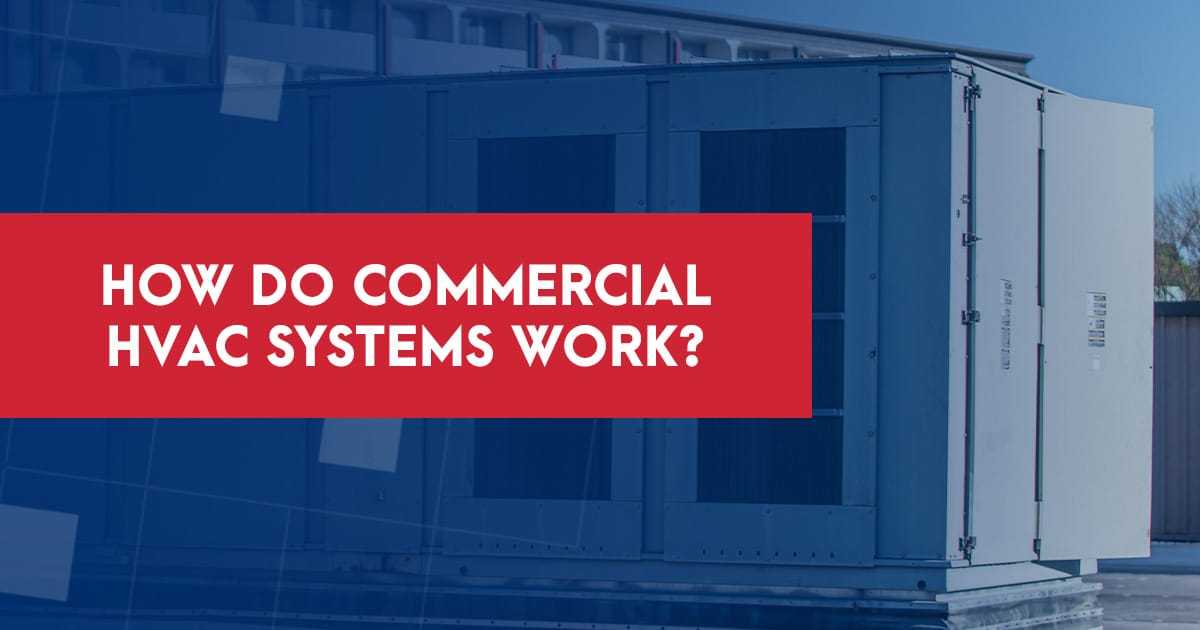
Though they can be installed on a slab at ground level, these all-in-one HVAC systems are typically installed on the roof of a building. That’s why you’ll sometimes hear packaged HVAC systems referred to as rooftop units, or RTUs.
Much like a split system you will have a supply and return that will draw air through a return then heat by a heat exchanger or heat strip, or cool by an evaporative DX cooling before being Discharged throughout the building through ducts.
While these outdoor units are built to be more durable and weather resistant, they’re exposed to the elements much more than other systems. So it’s important to keep up with regular maintenance and servicing.
Thankfully, rooftop units are much easier for professional HVAC technicians to access. And since they consume less energy than split systems, you can save money on commercial heating and cooling.
Packaged HVAC systems are a popular choice for low-rise commercial buildings such as office towers, retail stores, and warehouses.
VRF/VRV HVAC systems
Variable refrigerant flow (VRF) or variable refrigerant volume HVAC systems are refrigerant-based air conditioning systems.
Similar to traditional air con, they consist of a fan coil unit inside and a condenser unit outside. But the main difference is how they pump air into your commercial building.
While other systems use a single large unit to pump air, VRF/VRV systems use many smaller air handlers. Each one can be controlled independently.
VRF/VRV HVAC systems are completely ductless. So they need to send out refrigerant using one of two alternative methods:
- Heat recovery : Works by collecting waste heat from warmer rooms and using it to heat cooler ones. This is ideal for properties with many rooms and allows the system to heat and cool simultaneously.
- Heat pump : Evenly provides either heating or cooling to larger open-plan areas.
These systems are intended for use in larger commercial premises, including mixed-use buildings and large hotels. Though they’re more expensive than other types of commercial HVAC systems, they also perform 30% more efficiently than ducted systems.
VRF/VRV systems also feature more sophisticated environmental controls. This gives you total freedom to heat and cool your workspace as necessary.
Call DMC Service for commercial HVAC maintenance and repair
Knowing which type of commercial HVAC system you have and how it works helps you take better care of it. This ensures a healthier and more comfortable environment for employees and visiting clients.
However, when you need routine HVAC maintenance or emergency repair, it’s quicker, cheaper, and easier to call in the pros. So reach out to the certified HVAC experts at DMC Service today for trusted commercial HVAC and repair in the Kansas City metro area.
What Our Customers Say
The owner and the staff at DMC Service are amazing. They are unfailingly kind and helpful people who listen carefully and quickly find solutions. The technicians are prompt and reliable. It's always a pleasure to find skilled and honest people to do business with, and DMC Service is exceptional from start to finish. I most highly recommend DMC Service.
Great company great service. We have used them for several calls at several locations. I can count on them to fix problems.
DMC has been my go to for numerous things! They replaced my water heater when it finally stopped working. Karen and her amazing team really do deliver Diamond Service! As a woman homeowner you can feel confident selecting DMC for your HVAC/plumbing needs!
Wish it was all this easy! My project's bid was within 24 hrs. Crew was on time (early even), very courteous, and identified themselves at the door. No surprises. The area was as clean as when they found it. Communication was AMAZING. Thank you DMC!
DMC was recommended to us by my cousin who owns a plumbing company. Both technicians were extremely professional and courteous. They took the necessary extra time to ensure the job was done right. We felt the price was fair and a good value. We would highly recommend!
We worked with Kyle from DMC and you can tell he loves what he does. He is enthusiastic about the trade, and takes time to break it down and explain it in an easy-to-understand way. We are very pleased with our experience and would recommend!
Basically, you all saved our lives! We had a major stench coming from the basement no one could figure out. You all found the source and went beyond to fix the problem. We are eternally grateful!
Talk to a DMC technician today
Call our 24/7 customer service line. We are Diamond Strong.